
Keywords
hemochromatosis
iron overload
How to Cite


Abstract
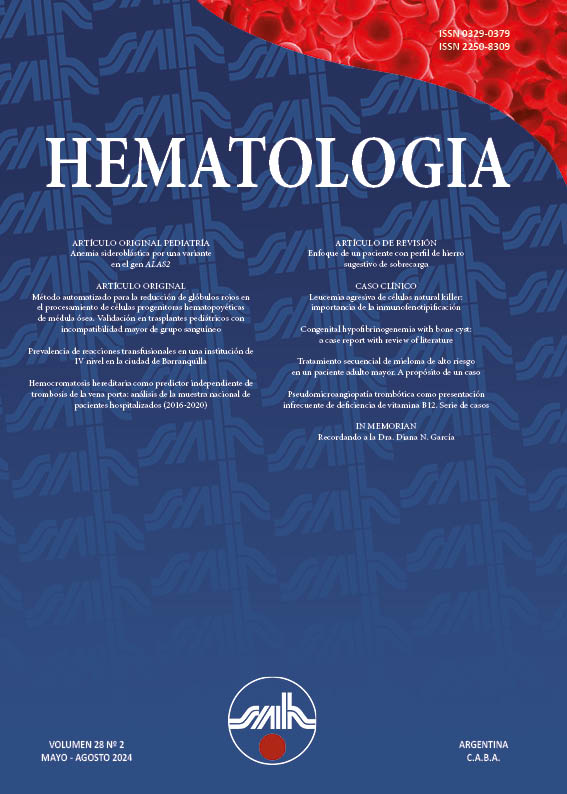
A basic iron profile often provides a useful approach to ferropenic or iron-sequestered inflammatory conditions, but sometimes also to the primary suspicion of iron overloading pathologies, which may or may not, at last, harbor a real iron overload. Therefore, a thoughtful interpretation of the results is mandatory to avoid misdiagnosis. The serum iron concentration reflects the quantity of iron moving at one moment from ferroportin- to transferrin receptor-1-expressing cells, while the transferrin concentration reflects the organism avidity for iron. But serum ferritin concentration may reflect iron deposits as well as inflammatory conditions, hence being difficult the interpretation of its normal or high values. In this paper I distinguish, among abnormal iron profiles, those with evident iron overload from those with hiperferritinemia without (clear) evidence of iron overload, although there is a frequent overlap between these two conditions. Secondary reactive hiperferritinemia is, by far, much more common than hiperferritinemia related to iron overload, as it is also frequent to deal with patients with more than one cause for their hiperferritinemia. "Reactive hiperferritinemia of unknown origin" should be the temporary diagnosis for patients with (yet) no evident etiology for their hiperferritinemia. Some patients have clearly absence or presence of iron overload, but in many cases this condition is doubtful, incomplete or intermittent. Hence, it is difficult in some cases to decide the need for chelation therapy. Iron overload, if present, may be secondary (basically to ineffective erythropoiesis) or primary. Primary iron overload may be, in turn, classified as hemochromatosic (HFE or non HFE) or non hemochromatosic. Although very rare, the non hemochromatosic primary iron overloads have confounding iron profiles, but with an easy approach if suspected. One of them, the ferroportin disease, just the opposite of hemochromatosis, deserves some attention, for it is not very infrequent. Finally, the diagnosis of hemochromatosis must be supported by an unequivocal typical iron profile and by biallelic severe HFE mutations or, rarer, mutations in non-HFE genes. The last but not the least, mild HFE mutations, as H63D, either mono o biallelic, do not justify by themselves any typical iron overload. In presence of such a genetic diagnosis, other cause(s) of iron overload must be looked for: non-HFE hemochromatosis if the iron profile is typically hemochromatosic, non-hemochromatosic iron overload (primary o secondary) if not. The risk of considering a mild HFE mutation (even in the case of HFE C282Y/H63D double heterozygous) as responsible for an iron overload or a hiperferritinemia is to overlook other causes for these conditions that may deserve particular and, eventually, more imperative attention and treatment.
References
Fonseca Ó, Ramos AS, Gomes LTS y col. New Perspectives on Circulating Ferritin: Its Role in Health and Disease. Molecules. 2023 Nov 22;28(23):7707. doi: 10.3390/molecules28237707.
Cohen LA, Gutierrez L, Weiss A y col. Serum ferritin is derived primarily from macrophages through a nonclassical secretory pathway. Blood. 2010 Sep 2;116(9):1574-84. doi: 10.1182/blood-2009-11-253815.
Wang W, Knovich MA, Coffman LG y col. Serum ferritin: Past, present and future. Biochim Biophys Acta. 2010 Aug;1800(8):760-9. doi: 10.1016/j.bbagen.2010.03.011.
Curtis AR, Fey C, Morris CM y col. Mutation in the gene encoding ferritin light polypeptide causes dominant adult-onset basal ganglia disease. Nat Genet. 2001 Aug;28(4):350-4. doi: 10.1038/ng571.
Vidal R, Ghetti B, Takao M y col. Intracellular ferritin accumulation in neural and extraneural tissue characterizes a neurodegenerative disease associated with a mutation in the ferritin light polypeptide gene. J Neuropathol Exp Neurol. 2004 Apr;63(4):363-80. doi: 10.1093/jnen/63.4.363.
Levi S, Cozzi A, Arosio P. Neuroferritinopathy: a neurodegenerative disorder associated with L-ferritin mutation. Best Pract Res Clin Haematol. 2005 Jun;18(2):265-76. doi: 10.1016/j.beha.2004.08.021.
Lorcerie B, Audia S, Samson M y col. Diagnosis of hyperferritinemia in routine clinical practice. Presse Med. 2017 Dec;46(12 Pt 2):e329-e338. doi: 10.1016/j.lpm.2017.09.028.
Hearnshaw S, Thompson NP, McGill A. The epidemiology of hyperferritinaemia. World J Gastroenterol. 2006 Sep 28;12(36):5866-9. doi: 10.3748/wjg.v12.i36.5866.
Sandnes M, Ulvik RJ, Vorland M y col. Hyperferritinemia-A Clinical Overview. J Clin Med. 2021 May 7;10(9):2008. doi: 10.3390/jcm10092008.
Camaschella C, Poggiali E. Towards explaining "unexplained hyperferritinemia". Haematologica. 2009 Mar;94(3):307-9. doi: 10.3324/haematol.2008.005405.
Adams PC, Barton JC. A diagnostic approach to hyperferritinemia with a non-elevated transferrin saturation. J Hepatol. 2011 Aug;55(2):453-8. doi: 10.1016/j.jhep.2011.02.010.
Sogni P, Buffet C. Démarche clinique devant une hyperferritinémie [Clinical evaluation of a hyperferritinemia]. Presse Med. 2013 Apr;42(4 Pt 1):405-10.
VanWagner LB, Green RM. Elevated serum ferritin. JAMA. 2014 Aug 20;312(7):743-4. doi: 10.1001/jama.2014.302.
Ong SY, Nicoll AJ, Delatycki MB. How should hyperferritinaemia be investigated and managed? Eur J Intern Med. 2016 Sep;33:21-7. doi: 10.1016/j.ejim.2016.05.014.
Ravasi G, Pelucchi S, Mariani R y col. Unexplained isolated hyperferritinemia without iron overload. Am J Hematol. 2017 Apr;92(4):338-343. doi: 10.1002/ajh.24641.
Cullis JO, Fitzsimons EJ, Griffiths WJ y col; British Society for Haematology. Investigation and management of a raised serum ferritin. Br J Haematol. 2018 May;181(3):331-340. doi: 10.1111/bjh.15166.
Cadenas B, Fita-Torró J, Bermúdez-Cortés M y col. L-Ferritin: One Gene, Five Diseases; from Hereditary Hyperferritinemia to Hypoferritinemia-Report of New Cases. Pharmaceuticals (Basel). 2019 Jan 23;12(1):17. doi: 10.3390/ph12010017.
Kannengiesser C, Jouanolle AM, Hetet G y col. A new missense mutation in the L ferritin coding sequence associated with elevated levels of glycosylated ferritin in serum and absence of iron overload. Haematologica. 2009 Mar;94(3):335-9. doi: 10.3324/haematol.2008.000125.
All material published in the journal HEMATOLOGÍA (electronic and print version) is transferred to the Argentinean Society of Hematology. In accordance with the copyright Act (Act 11 723), a copyright transfer form will be sent to the authors of approved works, which has to be signed by all the authors before its publication. Authors should keep a copy of the original since the journal is not responsible for damages or losses of the material that was submitted. Authors should send an electronic version to the email: revista@sah.org.ar